Temple of Minerva and the Forum
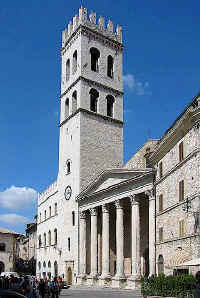
The Temple of Minerva has a perfectly preserved façade and is one of the most complete and legible examples of Roman sacred architecture. It was built on one of the terraces of the ancient town, the central terrace that faced the square below, identified as the forum.
It has a square cella preceded by a very short pronaos, now covered by a cloister vault. The cella was made from small blocks of local limestone joined with mortar; its façade and counter face are visible, while the side walls have been incorporated into the
Church of Santa Maria sopra Minerva, built in the 17 C. In front, six fluted Corinthian columns stand on high plinths, topped by capitals with a double order of acanthus leaves.
Above them rests the architrave, upon which there was a dedicatory inscription with bronze letters, now lost. The message can be deduced from their position, however, and it referred to the five-year quadrumvirate who had the temple built at their own expense. The building dates from the 1st
century BC. The square below it is identified as the city’s forum. It was reached by means of two symmetrical stairways opened into the temple support wall. The forum was paved with square slabs of limestone and was surrounded on three sides by a colonnade of Doric columns.
|
 |
The Roman Houses
Underneath the apse of the
Church of Santa Maria Maggiore there are the remains of a wealthy Roman
villa (domus). Excavations in the 1800s and mid-1900s have unearthed three communicating rooms, two of which
preserve their original mosaic floor and the remains of painted wall decorations. One room has a floor in opus sectile made up of squares of colored marble (antique yellow, porta
santa, pavonazzetto, africano, veined grey, etc.), evidence of the house’s
magnificence. The other room has a floor in black and white mosaic with marble inserts, and painted decoration on the walls, with plant and animal motifs over a red background. Next to the three rooms a long section of cryptoporticus (a vault-covered portico) was found, which most likely had surrounded an open central area, probably used as a garden and adjacent to the three rooms. It has walls painted with fine decorations over a yellow ground, divided into three horizontal sections. The middle section is divided vertically by palm trees and candelabra; between these, small tablets
(pinakes) are painted in tempera. The northern wall has a niche (viridarium) decorated with delicate green shoots and small red blossoms, upon which are perched small birds of various shapes and colors.
Stylistically, the paintings can be included in the early stage of the 4th Pompeian style, and date from about the mid-1st century AD.
The scholar Guarducci attributes this house to the poet Propertius based
a graffito inside it in which it says “… I kissed the house of the Muse…”
The remains of a Roman
villa
from the first Imperial age (Julius-Claudia age) were unearthed during the excavation work
inside
Palazzo Giampè on Via Sant’Agnese in Assisi. This discovery is particularly important, both for the type of structure and for the excellent frescoes preserved in it. The excavations at the NE corner unearthed a
peristyle, or garden surrounded by a colonnade, of which three columns covered with three layers of plaster, a white and black mosaic floor, and plastered walls painted a Pompeian red color can be seen.
Facing the peristyle are a diaeta (sitting room), a triclinium (dining room) and a cubiculum (bedroom). These three rooms are decorated with splendid paintings (third Pompeian style), particularly those on the north wall of the
triclinium, which depicts architectural elements seen from the front and adorned with two griffins placed at the top of the trabeation and with small birds in three-quarter view. The middle of the north wall of the cubiculum was painted in Pompeian red, with a pinax or tablet with an elegant scene of a married couple at the center. The floor is paved with a white and black mosaic having a geometric pattern of hexagons with a
six-petalled flower at the centre. The superb frescoes give evidence of the great talent of the painters and the importance of the person commissioning the works, which are definitely
the only known example of Roman mural painting in Umbria and one of the few examples north of Rome.
Roman Cistern
Incorporated into
Assisi’s northeast terrace wall and perfectly preserved, the Roman cistern can be seen inside the
Cathedral of San Rufino, where it is used as the foundation for the bell tower.
The cistern is a quadrangular chamber built from square blocks (opus quadratum) of travertine without mortar, covered by a barrel vault made from well connected blocks. A projecting cornice runs along the longer sides and on the rear wall, marking the face upon which the ceiling rests. The water passed through a long, narrow, vertical opening in the rear wall, framed at the top by a ring of radial stones.
The monumental entrance reflects the public use of the cistern, which, given its capacity, was probably
utilised by the townspeople for drawing water. It dates from the latter half of the 2nd century BC.
Nymphaeum
At
Santureggio there are the remains of a nymphaeum that was probably first built in the late 2nd
century BC, and its greatest expansion and use can be dated between the late 1st
century BC and the mid 1st century AD. The nymphaeum is a monumental public fountain composed of a large rear wall in opus
quadratum, set on the side of a steep hill, and a large basin, paved with large slabs, for collecting water. It is closed off at the sides by two walls made from small blocks.
The rear wall has a deep recess (esedra) and an opening from which water would pour in, falling on the floor of the esedra and, after decanting, would go into the basin below. The water poured out from a shelf decorated with two lion
protomas. The finding of various votive objects shed light on the use of the
Nymphaeum, which must have been both a source of
clean water as well as a place of worship.
|
)
)
