Assisi

 Assisi - history and principal tour sights

Assisi Sights Calendimaggio Roman Assisi

Assisi

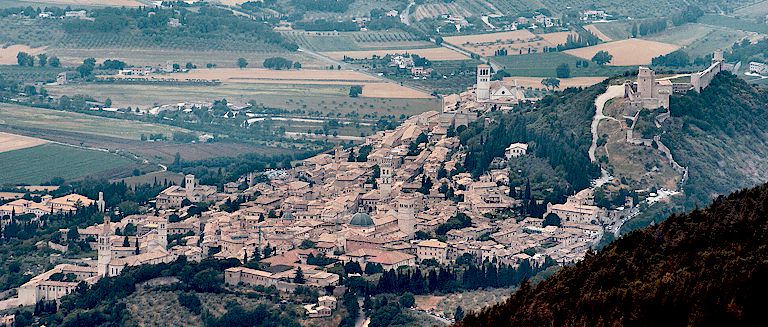
Panorama of the town of Assisi from Mt Subasio

Assisi - its history

Assisi is famous principally as the home of Saint Francis but of course it has a long and interesting pre-Franciscan history. Around 1000 BC, a wave of immigrants settled in the upper Tiber valley as far as the Adriatic Sea and also in the neighbourhood of Assisi. These were the Umbrians, a distinct people habitually living in small fortified settlements on high ground. From 450 BC these settlements were gradually taken over by the Etruscans. The Romans took control of central Italy after their victory at the Battle of Sentinum in 295 BC and, among many other things, they built the flourishing municipium Asisium on a series of terraces on Mount Subasio. Remains from Roman times can still be seen in Assisi: the city walls, the forum (now the Piazza del Comune), a theatre, an amphitheatre and the Temple of Minerva (now transformed into the Church of Santa Maria sopra Minerva). In 238 AD, Assisi was converted to Christianity by Bishop Rufino, who was martyred at Costano. According to tradition, his remains rest in the Cathedral Church of San Rufino in Assisi. After the fall of the Roman Empire, Assisi was besieged and conquered by the Goths (the Ostrogoths under king Totila destroyed most of the town in 545), retaken by the Byzantines and later fell to the Longobards and finally to the Frankish Holy Roman Empire. After a popular rebellion against the oppressive power of the Emperor Federick I Barbarossa was quelled by the imperial troops, Assisi was assigned to the Frankish Duchy of Spoleto in 1198 by the Pope Innocent III who confirmed the privileges of the church of Assisi with a papal bull and thereafter Assisi mirrored the fortunes of the Spoleto.

During the 11 C, Assisi began to exert its municipal freedom as a result of the religious and cultural awakening that was spreading rapidly all over Italy. Churches and monasteries were founded, castles were built or fortified and, for the first time, the plains below Assisi were turned to agricultural purposes, much aided by the exertions of Benedictine monks. The city, which had hitherto remained within the confines of the Roman walls, began to expand outside these walls in the 13 C. During this period the city was under papal jurisdiction. The Rocca Maggiore, the imperial fortress on top of the hill above the city, had been plundered by the populace in 1189, but was rebuilt in 1367 on orders of the papal delegate, Cardinal Gil de Albornoz. The thriving city had become an independent Ghibelline municipality in the 11 C. Constantly contending with the Guelph Perugia, it was during one of those battles, the battle at Ponte San Giovanni, that Francesco di Bernardone, (Saint Francis of Assisi), was taken prisoner, setting in motion the events that eventually led him to live as a beggar and renounce the world. Assisi eventually fell under the rule of Perugia and later under several despots, including the soldier of fortune Biordo Michelotti, Gian Galeazzo Visconti, Duke of Milan, Francesco I Sforza, another Duke of Milan, Jacopo Piccinino and Federico II da Montefeltro, lord of Urbino. As in much of Italy, the city went into a steep decline with the Black death in 1348 AD. The city came once again under papal jurisdiction under the rule of Pope Pius II (1458-1464).

The conquest of Umbria by Pope Paul III finally brought peace to Assisi. In 1569 construction of the Basilica of Santa Maria degli Angeli was started. During the Renaissance and later centuries, the city continued to develop peacefully, as attested by the 17 C palaces of the Bernabei and Giacobetti.

Assisi is now a famous pilgrimage destination inextricably linked in legend with its native son, St. Francis, who founded the Franciscan order and shares honours with St. Catherine of
Sienna as the patron saint of Italy. He is known by many as a lover of nature and his preaching to an audience of birds is one of the legends of his life.

Assisi was struck by the devastating twin earthquakes that shook Umbria in 1997, but the recovery and restoration have been remarkable, although much remains to be done. Massive damage was caused to many historical sites, but the major attraction, the Basilica di San Francesco, reopened less than two years later.

Assisi - the main sights

Basilica of St. Francis and the Sacro Convento

The basilica complex is composed of two churches built one above the other, the lower one dating from 1228-1230 and the upper one from 1230-1253, plus a crypt dug in 1818 to house the Saint's tomb. The Lower Basilica was decorated by the greatest painters of the 13 C and 14 C: Cimabue, Giotto, the Lorenzetti brothers and Simone Martini. The stained glass windows are especially beautiful. The Upper Basilica is adorned by Giotto's frescoes illustrating the life of St. Francis. There are also works by Cimabue, Cavallini and Torriti. The monastery houses a remarkable "Treasury" composed of rare illuminated manuscripts and the Perkins collection.

Basilica of St. Francis and the Sacro Convento

Via S. Francesco

On this street are the 13 C House of the Maestri Comacini, the Oratorio Temple of Minerva dei Pellegrini (with 15 C frescos), Palazzo Giacobetti (Vallemani) with the Municipal Art Gallery (Pinacoteca Comunale) containing frescos from various schools, the Monte Frumentario (13 C) and Fonte Oliviera (16 C).

Piazza del Comune

The Roman Temple of Minerva (dating from the 1st century B.C.), the 13 C Palazzo del Capitano del Popolo, the Torre del Popolo, completed in 1305, and the Palazzo dei Priori (14 C). The Roman Forum is located below Piazza del Comune and encompasses the original Roman paving and the base of the temple of Minerva.

Chiesa Nuova

This church was built in 1615 on the remains of a building believed to be the house of St. Francis' family. St. Francis was supposedly born in the nearby Oratorio di San Francesco Piccolino.

Chiesa Nuova

Basilica of St. Clare

This church is an example of Italian Gothic architecture. It was constructed between 1257-1265 and contains precious paintings dating from the 12 C - 14 C and the famous Crucifix venerated by St. Francis at San Damiano. The body of St. Clare is preserved in the crypt.

Basilica di Santa Chiara

Cathedral of St. Rufino

The impressive Romanesque facade dating from 1140 is adorned with three rose-windows and symbolic sculptures. The interior was altered in the 16 C, but there is still the baptismal font where St. Francis and St. Claire were baptised. The Cappella del Sacramento, the wooden choir, the Roman cistern, the crypt and the museum are points of interest.

Cathedral of St. Rufino

Rocca Maggiore

A typical example of mediaeval military architecture with a splendid view from the top.

Rocca Maggiore


Church of San Pietro

with its elegant facade and original dome; Fonte Marcella (16 C). 

Church of San Pietro

Other monuments include the Church of Santo Stefano (13 C) in one of the most picturesque corners of the town and the Romanesque Church of Santa Maria Maggiore, first cathedral of Assisi. 

Outside Assisi

S. Maria degli Angeli

This suburb of Assisi is about 5 km away and is the location of an imposing basilica constructed between 1569 and 1679 and crowned by the magnificent dome designed by Alessi. It encloses the Porziuncola (the nucleus of the first Franciscan monastery and the place where St. Clare received the Franciscan cowl from St. Francis in 1211) and the Cappella del Transito where St. Francis died on 3 October 1226. To the side of the basilica is the Chapel of the Roses with frescoes by Tiberio d'Assisi. The Museum annex contains works by the Maestro di San Francesco, Giunta Pisano and others.

Basilica of Santa Maria degli Angeli

San Damiano

San Damiano is a Franciscan shrine about 1.5 km from Assisi, built on the spot where St. Francis heard the voice of Christ and where he wrote the Canticle of the Creatures.

San Damiano cloister

Eremo delle Carceri

The convent founded by St. Claire is still intact. The Hermitage (Eremo delle Carceri) is an oasis of peace and tranquility in the midst of the woods of Mt. Subasio (4.5 kms. from Assisi).

Eremo delle Carceri

Sanctuary of Rivotorto

Here, 4.5 km from Assisi, the "hovel of St. Francis" is preserved in memory of the first Franciscan community.

Abbey of San Benedetto

On Mt. Subasio there is an ancient Benedictine settlement about 7 km from Assisi with two Romanesque crypts. 

Rocca Sant'Angelo

At Rocca Sant'Angelo (11 km from Assisi) there is an old Franciscan monastery. In its church are paintings by followers of Giotto and painters from the Umbrian school.

Full-day Excursions from Florence to Assisi and Spello
Maurizio Manuelli's Minibus Service

Assisi tours

• Full-day excursions to Arezzo, Sansepolcro, Anghiari, Cortona.

• Full-day excursions to
Urbino.

Full-day excursions to Assisi and Spello.

Click here for more about Maurizio's minibus service.

Assisi Sights Calendimaggio Roman Assisi

© ammonet 2006 - 2008 All rights reserved.